



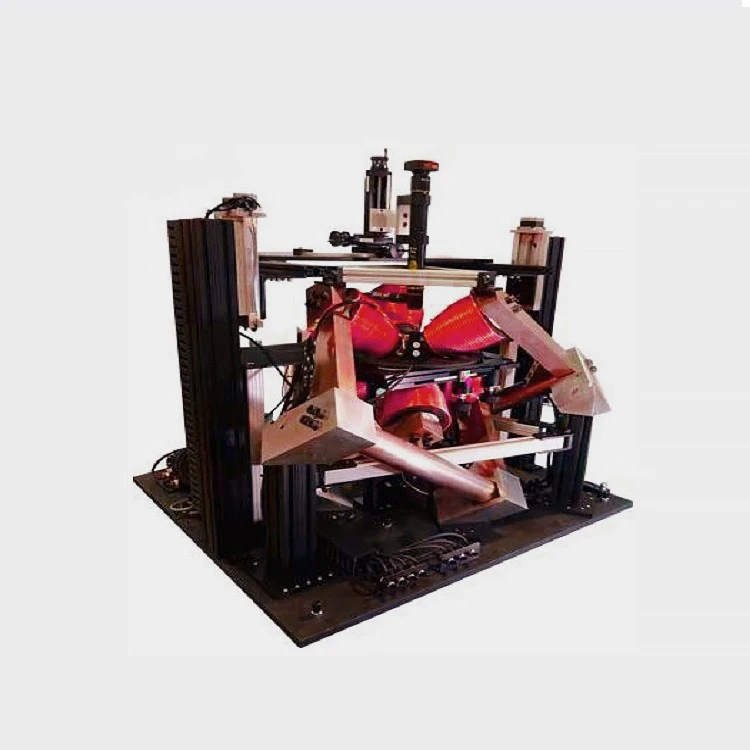
Product Introduction
1. Product Overview
Dexinmag 3D magnetic field probe station is a device designed for scientific research and industrial applications. It is widely used in the semiconductor industry, MEM, superconducting, electronics, iron electronics, physics, material science biomedical and other fields. It combines advanced magnetic field generation technology and precision probe detection technology to provide users with a comprehensive and efficient test solution in a comprehensive and efficient three-dimensional magnetic field environment.
2. Product characteristics
3D magnetic field generator: This probe station uses a unique magnetic field generation technology to produce precisely controlled 3D magnetic fields. Users can adjust the direction, strength and distribution of the magnetic field according to the needs to meet the test needs in various complex environments.
High-efficiency cooling system: The coil can use gas cooling (suitable for smaller magnetic fields) or water cooling (suitable for larger magnetic fields) to effectively ensure the stability and persistence of magnetic field production. At the same time, the equipped coil overheating protection device further enhances the safety and reliability of the equipment.
High-precision bipolar DC power supply: Combined with the high-precision bipolar DC power supply generated by Dexinmag, this probe station can work steadily.
Flexible sample table design: The sample table can achieve two-dimensional movement and 360-degree rotation in the horizontal direction, which greatly facilitates the installation and testing process of the sample. At the same time, the sample table can adapt to different sizes of wafers and devices, which improves the flexibility and efficiency of testing.
High-precision probe technology: equipped with four high-precision probes, support DC or low-frequency AC signal testing, which can accurately measure various parameters under the action of magnetic fields such as chips, wafers, and packaging equipment. At the same time, the high-precision electron microscope is favorable to observe small samples.
3. Applications
Dexinmag 3D magnetic field probe stations are widely used in the semiconductor industry, MEM, superconducting, electronics, iron electronics, physics, material science and biomedical and other fields. Through the real bipolar power output, this probe station can achieve vector occasions in any direction in the space to provide users with a comprehensive test solution.
4. Optional accessories
(1). Various DC probe, high-frequency probe, activity probe, etc. to meet different test needs.
(2). Cable, CCD or C-MOS video imaging equipment, which is convenient for observation and record testing.
(3). Chuck Motion Electromagnetic system/superconducting magnetic system is used to enhance the strength of the magnetic field or realize a specific magnetic field environment.
(4). 1MPA positive pressure system upgrade, ultra-high temperature upgrade options, ultra-high vacuum upgrade options, etc. to meet test needs in a special environment.
(5). Various probral fixed devices, shielding box reflective tables, adapter, etc. to improve the stability and accuracy of the test.
(6). Silent vacuum pump to ensure the cleaning and quiet test environment.
5. Parameters
|
Three-dimensional magnetic field probe station |
|||
|
Model |
DX3PS1 |
DX3PS2 |
DX3PS3 |
|
Material |
selected materials are high-quality, non-magnetic material |
||
|
Magnetic Field Range |
500Gs |
300Gs |
100GS |
|
Coil Material |
high-quality high temperature resistant enameled wire |
||
|
Magnetic field uniformity |
center area 50mm sphere within 1% |
||
|
Power stability |
three high precision DC power supply 50ppm optional 10ppm |
||
|
Magnetic Field Resolution |
0.05mT |
||
|
Angular resolution |
0.02 ° |
||
|
Sample fixing method |
suction cup or tablet |
||
|
Sample table diameter |
50mm can be customized |
||
|
Microscope |
X and Y planes 2*2inch, accuracy 1μm,Z axis travel ≥ 50.8mm, optional loading laser |
||
|
Magnification |
16 ~ 100X/20 ~ 4000X |
||
|
Number of probe arms |
2, 4 optional |
||
|
Probe arm travel |
25 mm-25mm-12mm replaceable |
||
|
Probe arm movement accuracy |
10um/2um/1um/0.7μm optional |
||
|
Probe length |
38mm |
||
|
Probe diameter |
0.51mm |
||
|
Needle diameter |
10μm/5μm/1μm |
||
|
Probe material |
Tungsten/Beryllium Copper/GGB |
||
|
Leakage accuracy |
100fA |
||
|
Microscope |
X and Y planes 2*2inch, accuracy 1μm,Z axis travel ≥ 50.8mm, optional loading laser |
||
6. Parameter confirmation before purchase
The maximum number of inches of wafers or devices that need to be tested; whether it is necessary to test fragments or single chips; the smallest single chip size;
How high is the mechanical precision requirement of the probe station;
The electrode size of spot measurement sample; 100μm*100μm or 60μm*60μm pad, or the mini pad made by FIB, or the metal circuit inside the ic;
A maximum of several probes are required for point measurement at the same time;
Whether the probe card test will be used;
How much is the minimum resolution of the optical microscope required;
In terms of microscopy, is it necessary to add a polarizer for LC liquid crystal hotspot detection;
Whether the current requirement reaches 100fa or below during the probe spot test! Does the low capacitance requirement need to be 0.1pf; Whether there is a radio frequency requirement;
What are the connected test instrument interfaces;
Whether heating or cooling is required when testing the environment! Whether a closed cavity is required;
What about Chuck's leakage requirements; Do you need to add a low-impedance chuck;
Whether an anti-shock table is required;
If you add a shockproof table, whether there is compressed air.
Deliver, shipping and serving
In today's dynamic and continuous development business pattern, providing excellent customer service is essential to cultivate long -lasting customer relationships. We firmly maintained the method of "customer priority" and thoroughly evaluated the various ways of transportation of air and marine transportation. We are committed to formulating a customized solution, which are consistent with the specific requirements of customers as much as possible, constantly strive to excellence and surpass their expectations. We guarantee that every time the goods can accurately, safe, and accurately reach our destinations, provide a reliable delivery experience for our respectable customers. We deeply realize that customer satisfaction and trust are our most valuable assets and a catalyst for our permanent development.



FAQ
Question 1: What technologies did the three-dimensional magnetic field probe in the magnetic field calibration and verification?
Answer:
Hall effect sensor: use the Hall effect sensor for precise measurement and calibration of magnetic field distribution.
Laser interference measurement technology: Use laser interference measurement technology to calibrate the position of magnetic field probes.
3D magnetic field analog software: Adopt advanced magnetic field analog software to simulate and verify the magnetic field distribution through numerical calculations.
Automation calibration system: equipped with automated calibration system, automatically complete the magnetic field calibration process through the preset calibration procedures.
Question 2: What are the innovations of probe technology and measurement accuracy of the 3D magnetic field probe?
Answer:
Nano-level probe technology: The nano-level probe technology can be used to reach the nano-level diameter, which can achieve high precision measurement on the surface of the sample.
High-precision positioning technology: Use the precision displacement control system and sensor to achieve the high-precision positioning and movement of the probe in the three-dimensional space.
Temperature compensation technology: In response to the impact of temperature on magnetic field measurement accuracy, temperature compensation technology is adopted, and the environmental temperature is monitored in real-time and adjusted accordingly.
Multi-parameter measurement ability: In addition to the magnetic field measurement, it can also measure multiple parameters such as current, voltage, and temperature to provide comprehensive data support for material research and device testing.
Question 3: What are the development trends of the three-dimensional magnetic field probe in terms of automation and intelligence?
Answer:
Automation test process: reduce manual operation by introducing automated testing processes.
Intelligent data analysis: Use intelligent algorithms to automatically analyze and process test data, extract key information, and provide researchers with more valuable analysis results.
Remote control and monitoring: Support remote control and monitoring functions. Users can remotely operate equipment, view test results, and perform data analysis to improve the flexibility and ease of use of the equipment.
Integrated solution: Integrate the three-dimensional magnetic field probe and other testing equipment, control systems, etc., form a complete test solution, and provide users with one-stop testing services.