



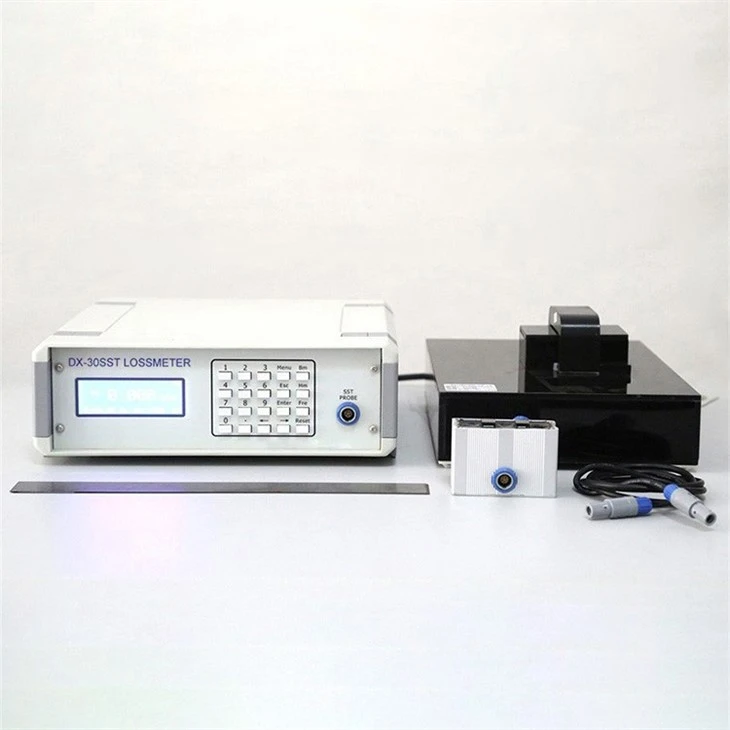
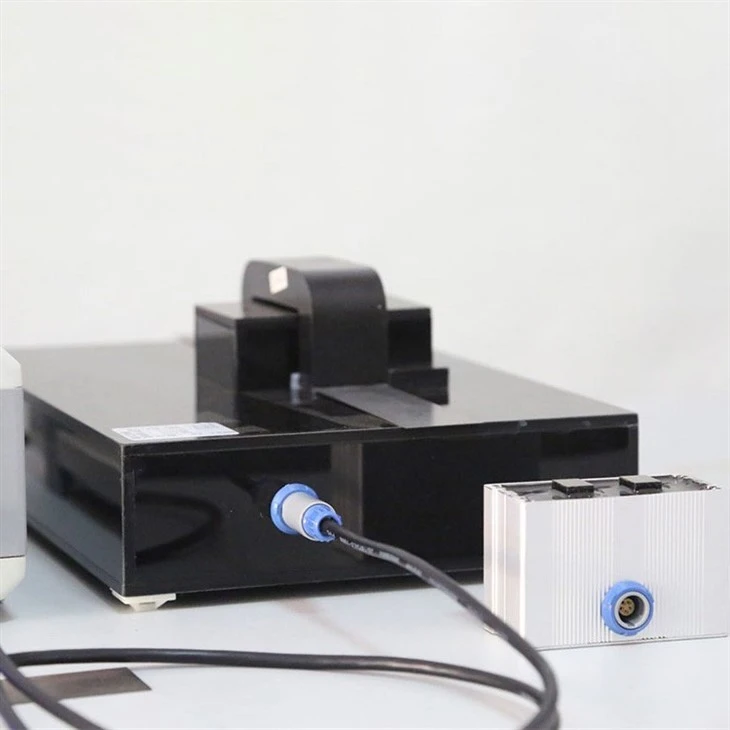
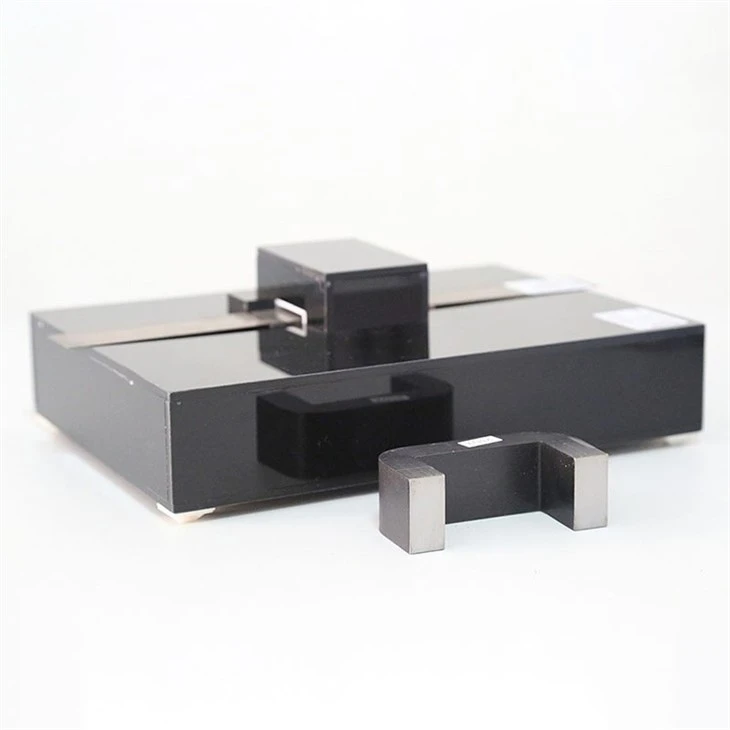
The DX-30SST core loss tester is a high-performance device that measures the characteristics of oriented and unoriented silicon steel sheets. It adopts advanced single-chip microcomputer technology and analog electronic technology and provides reliable data support for the quality control and grade tracking of silicon steel sheets by accurately measuring the mass-specific total loss Ps and magnetic induction strength Bm.
Design Characteristics
Small permeability meter design: DX-30SST type iron core loss tester adopts 30SST small permeability meter design through the transmission value traceability to the ring sample to ensure the accuracy and reliability of measurement results.
Effective magnetic circuit length determination: The tester can accurately determine the effective magnetic circuit length and complete air flux compensation to achieve direct measurement of a single sample.
Low-loss silicon steel sheet core: The magnetic circuit of the permeability meter uses a low-loss silicon steel sheet core to ensure the measurement's stability and accuracy.
Technical Standards and Circuit Design
Comply with Chinese industrial standards: The design of the hardware circuit strictly follows the Chinese industrial standards (GB / 3655-2000) to ensure the quality and performance of the product.
Real-time sampling and compensation technology: Through real-time sampling, the secondary induced voltage V and primary excitation current I are compensated, so that the air can reach 1.0mV or less, improving the measurement accuracy.
Wave feedback technology: The tester adopts wave feedback technology to ensure the sinusoidal waveform of the magnetic flux and make the measurement data more accurate and reliable.
Function Introduction
Accurate measurement: It can accurately measure the closed circuit permeameter of oriented and unoriented silicon steel to meet the measurement needs of different silicon steel sheet types.
Loss measurement: The P1.5/50 integral stator open circuit permeability meter loss measurement can be closed circuit or open circuit, locking magnetic induction Bm or excitation strength Hm after accurate measurement.
Zero flux compensation: The closed-loop permeameter realizes zero flux compensation, effectively eliminates external interference, and improves measurement stability and accuracy.
Standard square continuity: The micro square continues the standard square, ensuring the continuity and consistency of the measurement.
Easy to operate: operate directly on the panel, one machine can complete the test of the set value, which is a simple and convenient operation.
Data connection and software support: The RS232 interface can be connected to the PC, and the test software can easily measure the BH hysteresis loop, u-H permeability curve, Ps-B loss, and other data, which provides comprehensive data support for the performance analysis of silicon steel sheet.
Technical:
Input voltage: 220V±20V/0.5A, 50Hz
Output voltage: 15V/1.5A (50/60Hz)
Setting range of saturation magnetic induction Bm: 500mT~1900mT
Setting range of excitation magnetic strength Hm: 100A/m~10000A/m
Ps accuracy: 2.0%, Bm accuracy: 2.0%
Options:
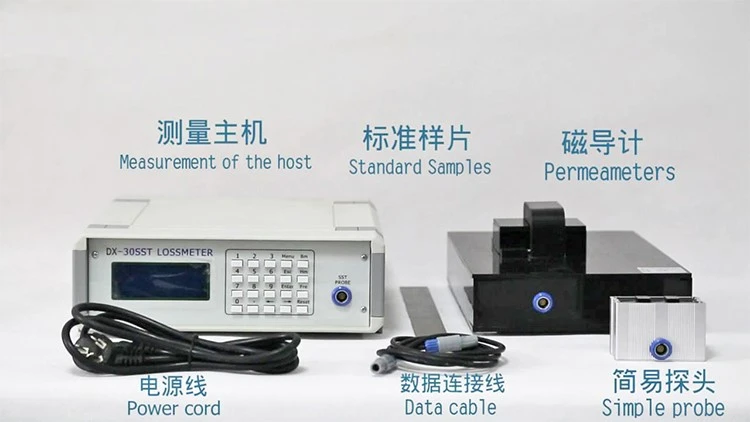
DX-30SST silicon steel sheet iron loss tester can be matched with different excitation tooling according to the actual test.
Open circuit permeameter: suitable for the monolithic test in the finished silicon stator. It can directly test under P1.5/50, with an accuracy of 5.0%.
Closed-circuit permeameter: suitable for accurately measuring the monolithic silicon stator's length is above 150mm and width between 20mm and 30mm.
DX-30SST test software: realize the measurement of Hysteresis loop, demagnetization curve, Ps, Bm, Br, Hc,ua, δ, etc.
Deliver, shipping and serving
In a market environment full of crises, providing excellent supply chain services is critical to cultivating and maintaining the trust of valued customers. Our approach is rooted in a customer-centric philosophy, and we carry out rigorous evaluations of various modes of transport, including sea, air, land, and more. This ensures that we can provide customized logistics solutions according to the specific requirements of our customers. We are committed to exceeding our customers' expectations by ensuring each shipment's timely, safe, and accurate delivery to ensure its safe arrival at its intended destination.



FAQ
Question 1: How does the Core Loss Tester distinguish between different ferromagnetic materials?
Answer: A Core Loss Tester usually distinguishes different types of ferromagnetic materials by measuring and analyzing the magnetization curve and iron loss value of the ferromagnetic material in the AC magnetic field. Different types of ferromagnetic materials have different magnetization characteristics and iron loss characteristics. By comparing and analyzing these characteristics, the type of materials can be accurately identified.
Question 2: How can a Core Loss Tester avoid damage to electrical equipment during testing?
Answer: Select the right test conditions: According to the specifications and requirements of the electrical equipment, select the right test voltage, current, and frequency conditions to avoid exceeding the equipment's bearing range.
Connect the test line correctly: Ensure that the test line is connected correctly and firmly to avoid faults such as short circuits and open circuits.
Monitor the test process: During the test process, you should pay close attention to the operation of the electrical equipment and the change of the test data, and discover and handle the abnormal situation on time.
Set the test time reasonably: Avoid long continuous testing to reduce the loss and damage to electrical equipment.
Question 3: What challenges does Core Loss Tester face when measuring iron loss at high magnetic field strength?
Answer: Thermal effect: At high magnetic field intensity, ferromagnetic materials will generate more heat, which may cause the temperature of the test sample and the test instrument to rise, thus affecting the accuracy of the measurement results. Therefore, it is necessary to take appropriate heat dissipation measures.
Magnetic saturation: When the magnetic field strength reaches a certain degree, the ferromagnetic material may experience a magnetic saturation phenomenon, that is, its magnetization intensity no longer increases significantly with the increase of the magnetic field strength. This may impact the measurement of iron loss, as iron loss is often associated with changes in magnetization.
Electromagnetic interference: At high magnetic field strength, electromagnetic interference in the test environment may increase, interfering with the measurement results. Therefore, appropriate shielding and filtering measures must be taken to reduce the impact of electromagnetic interference.