



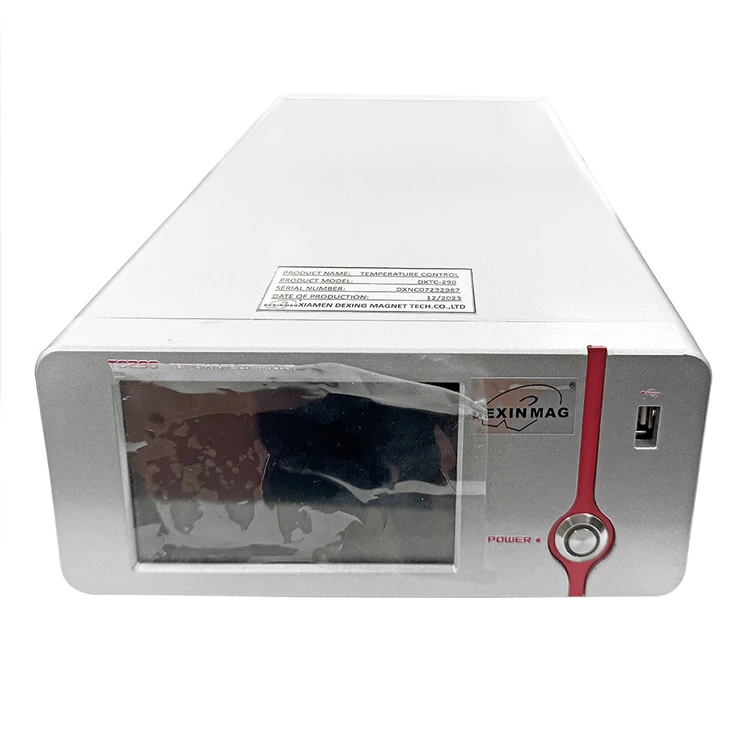

Ultra-low Temperature Controller
Introduction
DXTC-290 Ultra low temperature controller has excellent compatibility and scalability, supporting diodes, thermocouples, platinum resistance and negative temperature coefficient resistance sensors. Its unique design allows up to ten temperature sensors to be connected simultaneously, meeting the needs of multi-point testing in complex experiments.
In terms of performance, the DXTC-290 thermostat demonstrates extremely high resolution, accuracy and stability, which make it a benchmark of excellence in the industry. In addition, the thermostat is equipped with Ethernet, RS-485, USB and other communication methods, not only the data transmission distance is long, but also the data acquisition process is flexible and efficient.
The sensor part adopts the advanced dual constant current source mode to ensure the output balance and stability. In particular, it is worth mentioning that the constant current source can automatically shift at extremely low temperatures, effectively reducing the energy injection to the sensor, thus ensuring the stable and reliable operation of the sensor.
The DXTC-290 ultra low temperature controller has a unique dual control loop design, and the input of each loop can be associated with any of the ten sensors. Its powerful heating capacity can support up to two 100W or one 200W low noise heater to meet the needs of a variety of experimental scenarios. Closed-loop temperature control and self-tuning function further simplify the operation process and improve work efficiency.
Measurement parameters
◆ Measurement accuracy: the best measurement accuracy can reach 10mK;
◆ Measuring range: suitable NTC RTD sensor, measuring range can be as low as 300mK;
◆ Input channel: standard configuration 2 sensor input channels, up to 10, each channel has an independent temperature curve;
◆ Sensor compatibility: diode temperature sensor, Cernox temperature sensor, platinum resistance temperature sensor, thermocouple sensor, etc.
◆ Output control: three independent heating outputs, support ±10V analog voltage output, alarm and relay control;
◆ Measuring ADC: 24bit, update rate, 10 readings per second per channel;
◆ Thermoelectric potential compensation: support resistance sensor thermoelectric motive force compensation function;
◆ Network operation: multiple units can operate in a network. A single network allows up to 247 monitors to run simultaneously.
Control parameters
◆ Control loop: with double control loop, the first loop is 100W or upgraded to 200W low noise heating power supply, the second loop is 1W or upgraded to 100W low noise heating power supply;
◆ Signal filtering: filter window 1-10%FS, filter number 2 ~ 64;
◆ Control mode: automatic adjustment, manual setting, regional setting;
◆PID control: ratio 0 ~ 1000, set resolution 0.1; Integral 0 to 1000, set resolution 0.1; Difference 0 ~ 200, set resolution 0.1; Manually set the resolution from 0 to 100%, 0.01%.
◆ Area function: automatic switch sensor input, from 300mK to 1505K continuous measurement control;
◆ Safety protection: temperature set value limit, curve temperature limit, heating output slope limit, heating power gear limit, electric heating shutdown, heater short circuit protection.
◆ Display :5 inch color capacitive touch screen;
◆ Display mode: Chinese and English display, K, ℃, V, Ω multiple temperature units;
◆ Temperature display resolution :0.0001K;
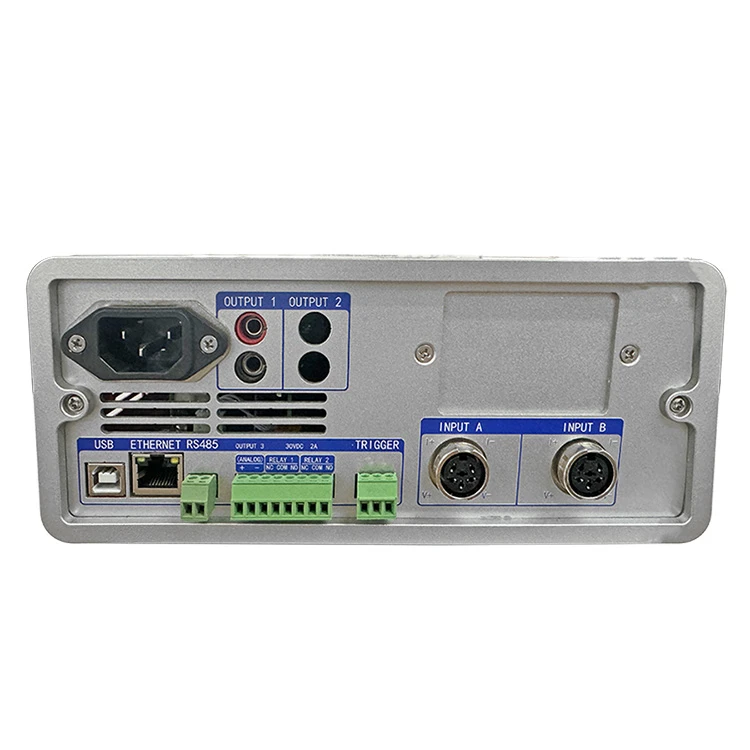
◆ Communication interface: standard Ethernet, RS-485, USB interface;
◆ Communication range: the transmission distance of RS-485 interface can reach 1200 meters, and the distance of Ethernet interface is basically unrestricted;
◆ Communication protocol: Support ECT custom protocol and standard MODBUS protocol;
◆ Software support: Provide LabView driver;
◆ Data storage: up to 64 temperature curves can be stored, including 20 curing standard temperature characteristic curves.
Sensor
|
Sensor type |
Material |
DX model |
LS model |
|
Diode |
Silicon |
DT64 |
DT-670 |
|
Gallium aluminum arsenic |
|
TG-120 |
|
|
Positive temperature coefficient |
platinum |
PT100 |
PT-100 |
|
Rhodium-iron |
RF50 |
RF-800-4 |
|
|
Negative temperature coefficient |
Germanium |
|
GR-200A-1000 |
|
Penetrating Ceramics |
CC870 |
|
|
|
Glassy carbon |
|
CGR-1-500 |
|
|
Cernox |
|
CX-1030 |
|
|
Oxide nails |
|
RX-202A |
|
|
DX is the abbreviation of Dexinmag company |
|||
Sensor input performance table
|
Sensor type |
Silicon diode |
Platinum resistor |
Cernox |
Carburized ceramics |
|
Temperature coefficient |
Negative temperature |
Positive temperature |
Negative temperature |
Positive temperature |
|
Signal category |
Voltage V |
Ohms (Ω) |
Ohms (Ω) |
Ohms (Ω) |
|
Signal range |
0~2.5V |
0~500Ω |
0~7500Ω |
0~4000Ω |
|
Excitation current |
10μA±0.01% |
1mA±0.3% |
Automatic shift |
Automatic shift |
|
Display resolution |
0.1μV |
0.1mΩ |
0.1mΩ |
0.1mQ |
|
Temperature range |
1.4~475K |
20~800K |
2.0~400K |
4~500K |
|
Standard curve |
LS:curve10 |
DIN43760 |
Requires calibration |
Requires calibration |
|
Measurement |
20uV |
2mQ |
50mΩ |
50mΩ |
|
Note 1: The driving principle of dual constant current sources for balanced output, that is, the two current output lines are centered to the ground, effectively suppressing common-mode interference and improving measurement accuracy; Note 2: Different excitation current ranges are used for different temperature zones of the sensor. The voltage on the sensor is monitored when the voltage exceeds After 10 mV, it automatically downshifts to bring the voltage back to 10 mV. This can control the injection energy of the sensor and ensure stable and reliable operation of the sensor at extremely low temperatures. |
||||