





Product introduction
The DX-60 Hall Effect Testing System consists of an electromagnet, electromagnet power supply, high-precision constant current source, high-precision voltmeter, Hall effect sample holder, standard samples, and system software. Specifically developed for this instrument system, the DX-320 Effectometer integrates the constant current source, six and a half digit microvolt meter, and complex Hall measurement switching relays-switches into one unit, greatly simplifying experiment wiring and operation.
The DX-320 can be used independently as a constant current source or microvolt meter. It is used to measure important parameters of semiconductor materials such as carrier concentration, mobility, resistivity, Hall coefficient, etc. These parameters are essential for understanding the electrical properties of semiconductor materials and devices, thus making the Hall effect testing system an indispensable tool for understanding and researching semiconductor devices and semiconductor material electrical properties.
Experimental results are automatically calculated by the software, providing simultaneous values for bulk carrier concentration, sheet carrier concentration, mobility, resistivity, Hall coefficient, magnetoresistance, and more.
Parameters of DX-60 Hall Effect Measurement Instrument
|
l parameters |
Carrier concentration |
10³cm⁻³ - 10²³cm⁻³ |
|
Mobility |
0 .1 cm²/ volt*sec - 10⁸cm²/ volt*sec |
|
|
Resistivity range |
10⁻⁷ Ohm*cm - 10¹² Ohm*cm |
|
|
Hall voltage |
1 uV - 3V |
|
|
Hall coefficient |
10⁻⁵ - 10²⁷cm³/ C |
|
|
Testable material type |
Semiconductor material |
SiGe, SiC, InAs, InGaAs, InP,AlGaAs, HgCdTe and ferrite materials etc. |
|
low resistance material |
Graphene, metals, transparent oxides, weakly magnetic semiconductor materials, TMR materials, etc. |
|
|
high resistance material |
Semi-insulating GaAs, GaN, CdTe, etc. |
|
|
Material Conductive Particles |
Type P and Type N testing of materials |
|
|
Magnetic field environment |
Magnet Type |
Variable electromagnet |
|
Magnitude of magnetic field |
1070mT (The pole pitch is 10mm) |
|
|
Uniform area |
1% |
|
|
Optional magnetic environment |
The electromagnet of relevant magnetic size can be customized according to the needs of customers |
|
|
Electrical parameters |
Current source |
50.00nA- 50.00mA |
|
Current source resolution |
0.0001uA |
|
|
Measuring voltage |
0 ~ ±3V |
|
|
Voltage measurement resolution |
0.0001 mV |
|
|
Other Accessories |
Shading |
Extern ally installed light-shielding parts make the test material more stable |
|
Sample size |
Maximum 10mm * 10mm |
|
|
Box cabinet |
600*600*1000mm |
|
|
Test piece |
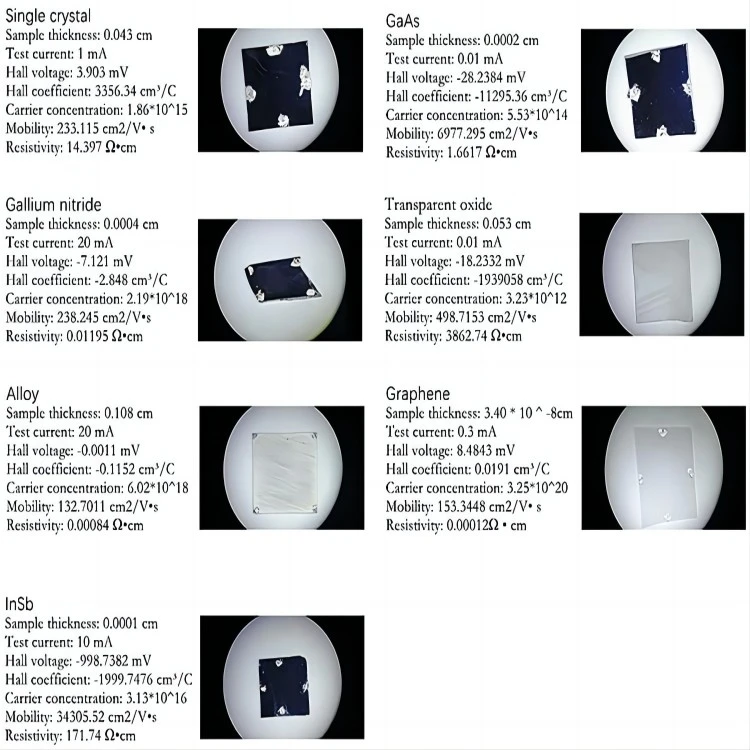
Hall effect of Institute of Semiconductors, Chinese Academy of Sciences Standard test samples and data: 1 set |
|
|
Making ohmic contacts |
Electric soldering iron, indium chip, solder, enameled wire, etc. |
|
|
One-button automatic measurement can be performed without the need for human operation after the test is started |
||
|
The software can perform I-V curve and BV curve |
||
|
Set in software for automatic temperature measurement |
||
|
The experimental results are measured, and the data will be temporarily saved in the software. If long-term storage is required, the data can be exported to an EXCEL table to facilitate later data processing. |
||
|
Provide the Hall effect standard test samples and data of the Institute of Semiconductors, Chinese Academy of Sciences: 1 set |
||
Testable samples of Hall device Instrument
FAQ